Research / Paper
Imitation-BT: Automating Behavior Tree Generation by Echoing Reinforcement Learning Agents
In short
Deep reinforcement learning policies work, but nobody can read them, which makes them hard to trust in places where mistakes are expensive. Behavior trees are the opposite: modular, reactive and readable node by node. Imitation-BT learns from a trained RL agent through interactive imitation learning and compiles what it learned into a compact behavior tree that keeps most of the agent's performance.
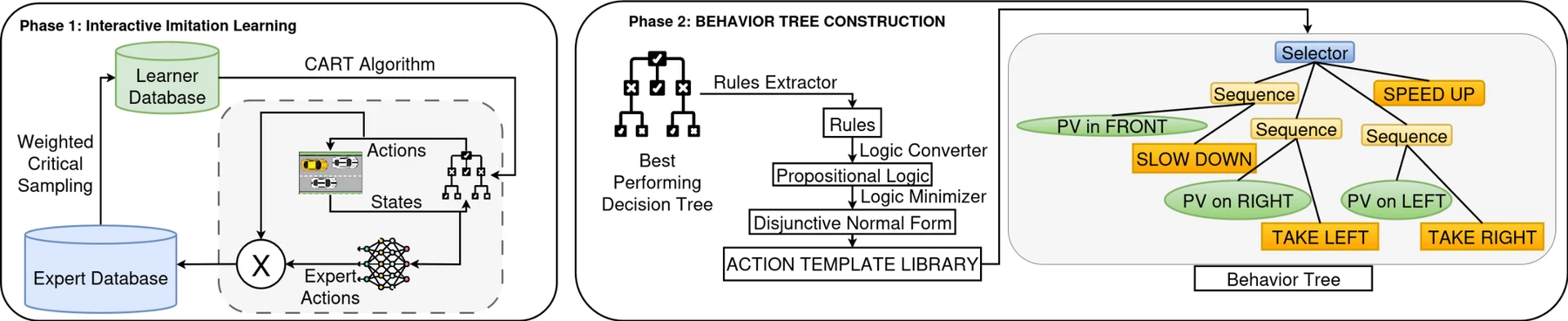
What it shows
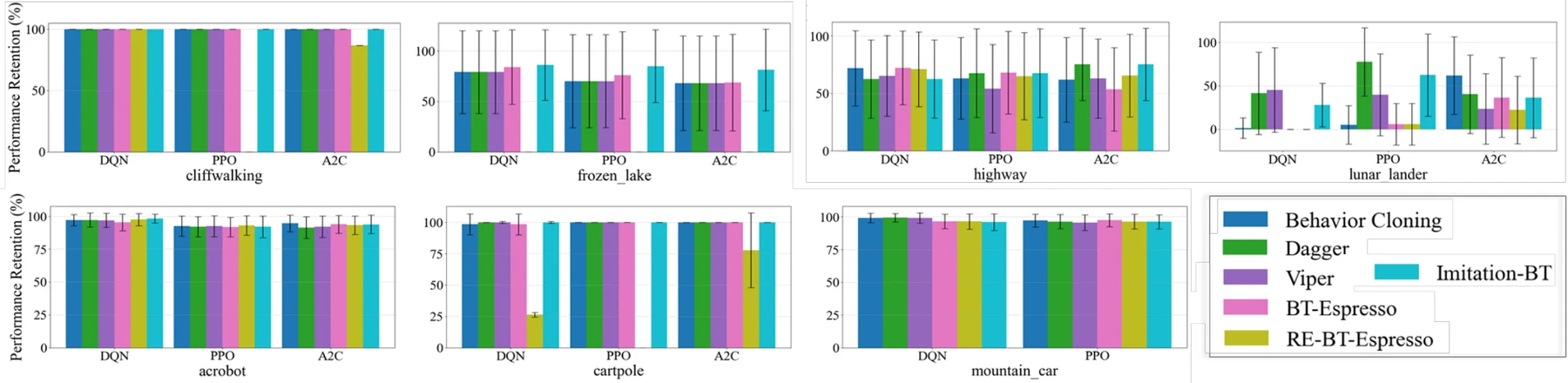
- 100%of the expert's performance at best: near-perfect replication on CartPole and Acrobot, where offline methods such as RE:BT-Espresso struggled.
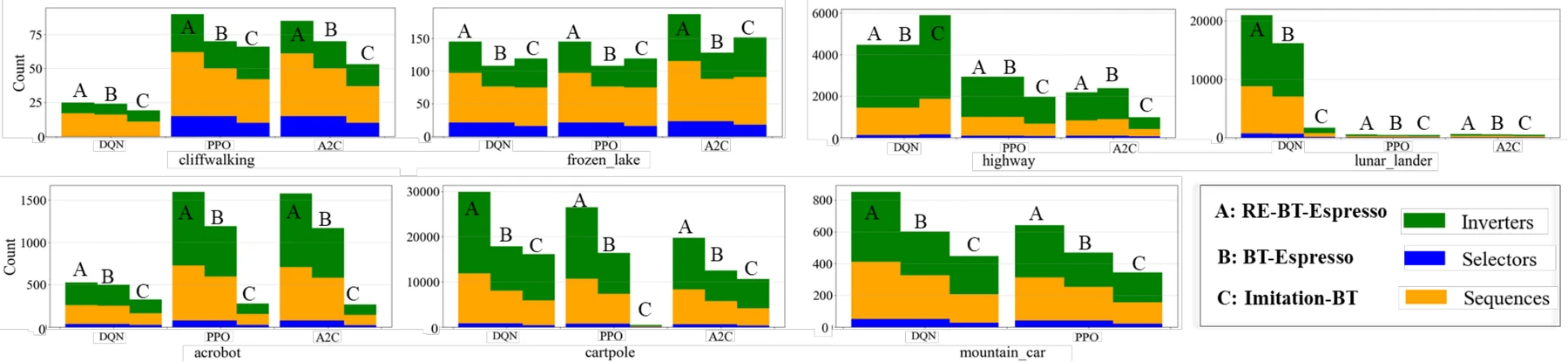
- ~10×fewer nodes than prior behavior tree synthesis in complex domains such as Lunar Lander.
- 7 + 1test domains: seven Gymnasium environments and a robot package delivery simulation, with DQN, PPO and A2C experts.
Abstract
Understanding an autonomous agent's decision-making prowess is of paramount importance, as it increases trust and guarantees safety. Although agent policies learned through reinforcement learning (RL) and machine learning (ML) paradigms have demonstrated their dominance in various domains, they struggle with deployment in high-stakes environments due to their algorithmic opacity. A structured and transparent representation of a policy helps us understand, evaluate, and modify it if necessary. Due to their inherent reactivity, modularity, and transparent hierarchical representation, the Behavior Tree (BT) is an ideal solution to represent control policies. In this paper, we focus on building a knowledge representation transfer framework in which knowledge of trained RL agents is captured through imitation learning and then utilized to form a compact BT. Our primary focus is to retain maximum performance while improving the interpretability of the BTs. In combination with planning and learning, we automate the formation of a BT and offer an alternative, transparent architecture for policy representation. In an extensive analysis with a variety of gymnasium environments and the Robotics Package Delivery domain simulations, we demonstrate the significant performance retention capability and superior interpretability of the proposed Imitation-BT.
Video
Cite
@inproceedings{bathula2026imitationbt,
  title     = {Imitation-BT: Automating Behavior Tree Generation by Echoing Reinforcement Learning Agents},
  author    = {Bathula, Shailendra Sekhar and Parasuraman, Ramviyas},
  booktitle = {2026 IEEE International Conference on Robotics and Automation (ICRA)},
  year      = {2026},
  address   = {Vienna, Austria}
}